Investing in an ATC (Automatic Tool Changer) CNC Router is a significant milestone for any woodworking business. It marks the transition from manual labor to industrial automation. A well-chosen machine can triple your production capacity, reduce labor costs, and pay for itself within months.
However, choosing the wrong machine can lead to production bottlenecks and frustration. With countless specifications—spindle power, bed size, controller types—how do you know which one fits your specific needs?
In this comprehensive guide, we break down the critical factors you must consider to make an informed investment, featuring insights from our professional ATC CNC Router Series.
Key Considerations: What Matters Most?
Don't just look at the price tag. Focus on the specifications that directly impact your daily workflow.
1. The Tool Changer Type: Linear vs. Carousel
This is the defining feature of an ATC machine.
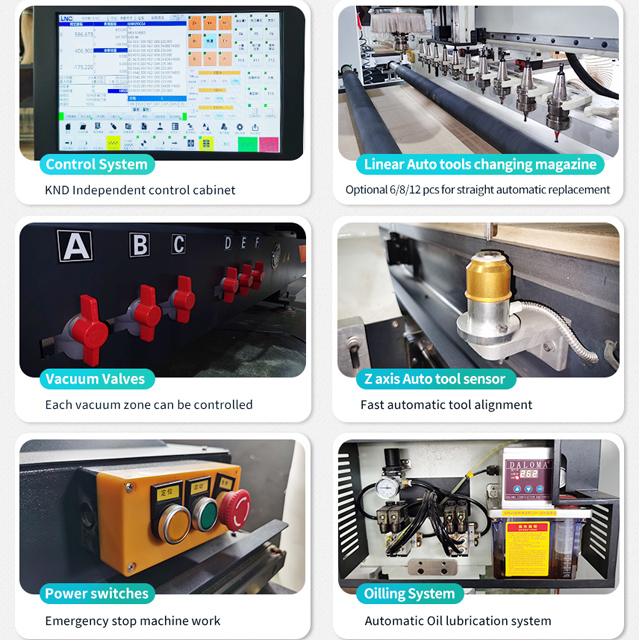
Linear ATC: A rack of tools sits at the back of the machine bed.
Pros: Simple structure, lower cost, easy to maintain.
Cons: Slightly slower tool change time (8-12 seconds) as the gantry must travel to the back of the bed.
Carousel (Rotary) ATC: A disk magazine rides along with the gantry.
Pros: Extremely fast tool changes (5-8 seconds). The tool is always right next to the spindle.
Verdict: Choose Carousel for high-volume production where every second counts. Choose Linear if you have a tighter budget but still need automation.
2. Spindle Power and Brand
The spindle is the heart of the router.
Power: For industrial cabinet making and nesting (cutting full sheets in one pass), you need at least a 9.0kW Air-Cooled Spindle. Anything less may struggle with thick hardwoods or fast feed rates.
Cooling: Air-cooled spindles are generally preferred for ATC machines due to their reliability and lower maintenance compared to water-cooled systems.
3. Working Area (Bed Size)
Match the machine size to your material supply.
1325 (4' x 8'): The industry standard. Fits most plywood and MDF sheets.
1530 (5' x 10'): Ideal for larger sheets often used in cabinetry to maximize yield.
2040 (6.5' x 13'): For specialized large-scale production.
4. Control System & Motors
Controller: Look for industrial systems like Syntec or LNC. They offer better stability for complex 3D curves than basic DSP handles.
Motors: Ensure the machine uses AC Servo Motors (e.g., Yaskawa or Delta). Never settle for stepper motors on an ATC machine; they lack the precision and speed required for automatic tool changing.
Market Recommendations: Top Picks
Based on customer feedback and performance data, here are three popular configurations from our ATC CNC Router Product List:
1. The All-Rounder: 1325 Linear ATC Router
Best For: Small to medium workshops upgrading from manual machines.
Key Feature: Cost-effective 8-tool linear magazine. It handles cutting, drilling, and engraving efficiently without breaking the bank.
2. The Speed Demon: 1530 Carousel ATC Router
Best For: Cabinet manufacturers and high-volume factories.
Key Feature: 12-tool rotary magazine + 9kW HSD Spindle. Designed for "Nesting" operations where speed is the priority.
3. The Specialist: ATC with Drilling Bank
Best For: Furniture makers requiring extensive vertical and horizontal drilling.
Key Feature: Adds a dedicated 9-hole drilling block (boring head) alongside the main spindle for ultra-fast hole processing.
Conclusion: Making the Smart Choice
Choosing the right ATC CNC Router is about balancing your budget with your production goals.
If you value speed above all else, invest in a Carousel ATC with high-end Servo motors.
If you need versatility on a budget, a Linear ATC is a robust workhorse that will serve you well for years.
The most expensive machine isn't always the best—the best machine is the one that solves your specific bottlenecks.
Ready to configure your machine? Browse our full ATC CNC Router Product List or contact our engineering team for a free consultation.
FAQ: Frequently Asked Questions
Q1: How much faster is an ATC router compared to a manual tool change router?
A: An ATC router can save 2-5 minutes per sheet of material. If you process 20 sheets a day, that saves over an hour of labor daily, allowing the operator to focus on other tasks.
Q2: Can I upgrade a standard CNC router to an ATC later?
A: Generally, no. ATC machines require specific wiring, pneumatic systems, and heavier gantries to support the tool changer. It is better to buy an ATC machine from the start if you anticipate needing one.
Q3: What software do I need for an ATC machine?
A: You need CAD/CAM software that supports tool numbering (like Vectric Aspire, Fusion 360, or Cabinet Vision). The post-processor must be configured to output the "T1 M6" codes that tell the machine to change tools.
Q4: What maintenance does an ATC system require?
A: Keep the tool holders (ISO30) clean and rust-free. Ensure your compressed air is dry to protect the pneumatic drawbar. Regularly check the tool sensor calibration.