The furniture manufacturing industry is undergoing a seismic shift. The days of relying solely on manual craftsmanship for mass production are fading. Today, the competitive edge belongs to workshops that embrace automation.
At the center of this revolution is the Wood CNC Router. From bespoke solid wood chairs to modular kitchen cabinets, CNC technology allows manufacturers to bridge the gap between artisanal quality and industrial speed.
In this article, we explore how upgrading to a professional Wood CNC Router is helping businesses scale up, reduce waste, and unlock new design possibilities.
Real-World Applications: Success Stories in Furniture Making
To understand the ROI (Return on Investment) of these machines, let’s look at three distinct manufacturing scenarios where CNC routers have changed the game.
Case Study 1: The Custom Cabinetry Shop (Panel Processing)
The Challenge: A mid-sized kitchen cabinet maker was struggling with material waste and slow turnaround times using traditional table saws.
The Solution: Implementing a 1325 ATC (Automatic Tool Changer) CNC Router with nesting software.
The Result:
Optimized Nesting: The software automatically arranges cabinet parts on a plywood sheet to minimize waste, saving up to 20% on material costs.
One-Pass Production: The machine drills shelf holes, cuts dadoes, and profiles edges in a single run.
Outcome: Production capacity tripled without hiring extra staff.
Case Study 2: High-End Solid Wood Furniture (3D Carving)
The Challenge: A boutique furniture brand needed to produce intricate, curved chair legs and ornate headboards that were too labor-intensive to carve by hand.
The Solution: Adopting a 4-Axis Wood CNC Router.
The Result:
Complex Geometry: The rotary axis allows the machine to carve 360 degrees around the wood, creating seamless, organic shapes.
Consistency: Every chair leg is identical to the millimeter, ensuring easy assembly and uniform quality.
Outcome: The brand could launch a new "Luxury Collection" that was previously impossible to manufacture profitably.
Case Study 3: Modular Office Furniture (Drilling & Cutting)
The Challenge: High-volume production of office desks requiring thousands of precise holes for cam-lock fasteners.
The Solution: A heavy-duty CNC Router equipped with a Multi-Spindle Drilling Bank.
The Result:
Speed: Instead of drilling one hole at a time, the machine drills 9 vertical holes simultaneously.
Precision: Perfect alignment means zero assembly issues for the end customer.
Industry Trends: The Future of CNC in Woodworking
As we look toward 2025 and beyond, Wood CNC Router technology continues to evolve. Here are the trends shaping the future:
Smart Factory Integration (IoT): Modern CNC routers are becoming "smart." They can communicate with design software in real-time, reporting job status and maintenance needs directly to the production manager's phone.
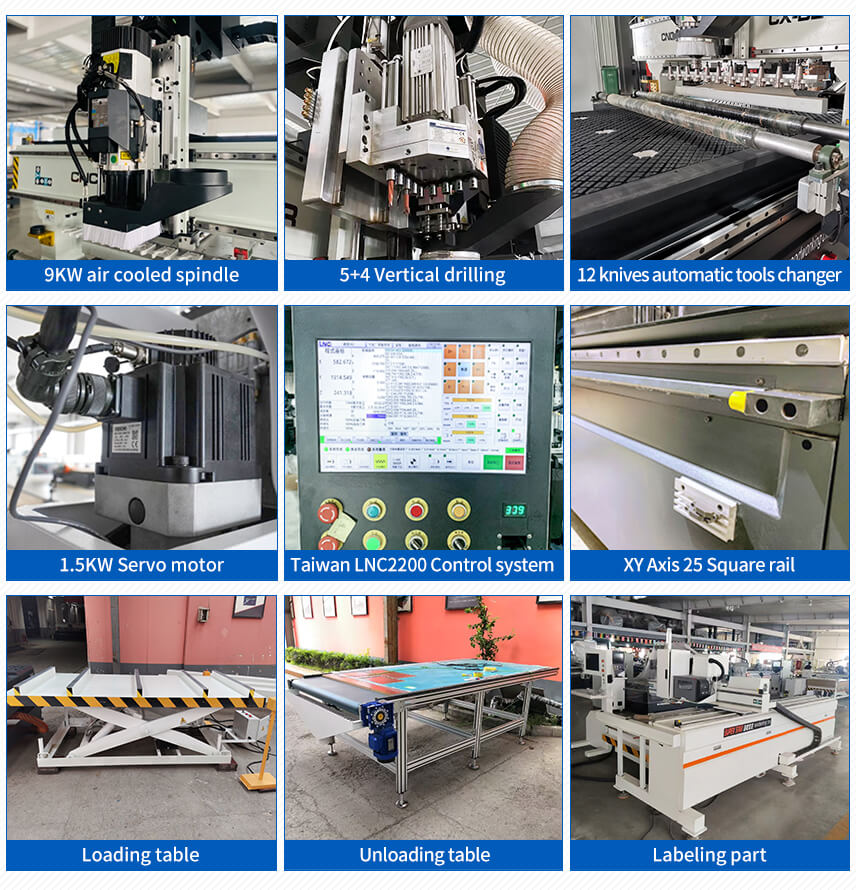
Automated Loading/Unloading: To further reduce labor costs, more factories are adding auto-loading platforms that feed panels into the router and push finished parts onto a conveyor belt.
Sustainable Manufacturing: With the rising cost of timber, the precision of CNC machines is vital for sustainability. Advanced nesting algorithms ensure that almost 95% of a raw board is utilized, significantly reducing the industry's carbon footprint.
Conclusion: The Impact on Your Business
The adoption of a Wood CNC Router is not just a purchase; it is a strategic partnership with technology. It allows furniture makers to:
Reduce Labor Costs: One operator can manage production that previously required three carpenters.
Increase Design Flexibility: If you can draw it in CAD, the machine can cut it.
Scale Rapidly: Meet large order deadlines with confidence.
Whether you are a small custom shop or a large factory, there is a machine configuration that fits your needs. Explore our comprehensive Wood CNC Router Product List to find the tool that will take your furniture production to the next level.
FAQ: Frequently Asked Questions
Q1: Is a CNC router better for solid wood or plywood/MDF?
A: It is excellent for both, but the setup differs. For plywood/MDF (cabinetry), a vacuum table and high-speed spindle are ideal. For solid wood, you might prefer a clamp table and a slower, high-torque cut for precision carving.
Q2: How long does it take to learn how to operate a Wood CNC Router for furniture?
A: With modern, user-friendly control systems, a basic operator can be trained in 3-5 days. However, mastering complex 3D design software (CAD/CAM) may take a few weeks of practice.
Q3: Can a CNC router replace a traditional table saw?
A: For curved cuts and complex shapes, yes. For straight cuts, a CNC router is more versatile because it can cut, drill, and groove simultaneously, whereas a table saw only cuts. Most modern shops use a CNC router as their primary cutting station.
Q4: What software do I need for furniture design?
A: Popular choices include Fusion 360, SketchUp (with plugins), Vectric Aspire, and Cabinet Vision. Ensure your machine's controller is compatible with the G-code output from these programs.