In the woodworking industry, there is a distinct difference between "custom fabrication" and "mass production." If your business involves producing hundreds of identical chair legs, stair balusters, or relief carvings, a standard single-spindle machine is a bottleneck.
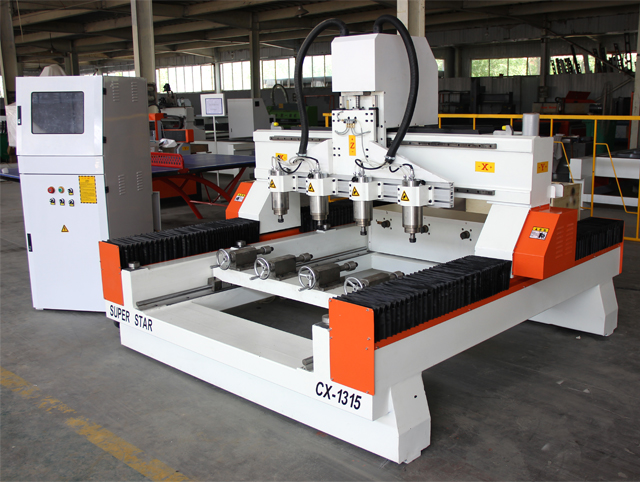
Enter the Multi-Spindle & Rotary CNC Router. This machine is designed for one purpose: Volume. By mounting multiple spindles on a single gantry and adding rotary axes, it allows you to process 4, 8, or even 10 workpieces simultaneously.
In this technical guide, we break down the specifications and functional advantages that make this machine the ultimate productivity tool for furniture manufacturers.
Technical Specifications: What Matters?
When evaluating a multi-spindle machine, the raw numbers tell the story of its capability. Here are the critical specs you need to understand.
Parameter
Standard Specification
Why It Matters
Spindle Count
2, 4, 6, 8, or Custom
Determines your multiplication factor. 4 spindles = 400% output in the same timeframe.
Spindle Power
2.2kW - 4.5kW (Water/Air Cooled)
Higher power allows for deeper cuts in hardwoods without stalling. Water cooling is preferred for long production runs.
Rotary Diameter
200mm - 400mm (Customizable)
Defines the maximum thickness of the column or statue you can carve.
Rotary Length
1200mm - 2500mm
Determines the maximum length of the workpiece (e.g., a long bedpost vs. a short corbel).
Controller
4-Axis DSP or Syntec
Essential for true simultaneous 4-axis linkage (moving X, Y, Z, and A axes together).
Z-Axis Clearance
300mm - 500mm
Higher clearance is needed to accommodate the rotary device and thick stock.
Functional Analysis: Beyond the Datasheet
The specs are impressive, but how do they translate to your workshop floor? Let's analyze the core functions of the Multi-Spindle & Rotary CNC Router.
1. Synchronous Multi-Head Machining
The defining feature is the ability to run all spindles simultaneously.
The Benefit: If a complex relief carving takes 2 hours to finish, a standard machine produces 1 piece in 2 hours. A 4-spindle machine produces 4 pieces in the same 2 hours.
Independent Control: Advanced models allow you to switch off specific spindles via the controller if you need to process a single large item, offering flexibility.
2. 4th Axis Rotary Processing (3D Carving)
Unlike a standard 3-axis machine that cuts on a flat plane, the rotary attachment rotates the workpiece while the spindle cuts.
Indexing vs. Continuous:
Indexing: Rotates the part 90 degrees, stops, and cuts a flat face.
Continuous 4-Axis: The part rotates while the cutter moves. This is essential for spiraling shapes, dragon columns, and complex statues.
Application: Perfect for stair handrails, sofa legs, Roman columns, and 3D sculptures.
3. Heavy-Duty Gantry Structure
Mounting 4 or 8 spindles adds significant weight to the gantry.
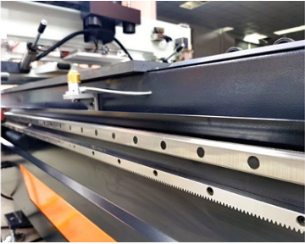
Rigidity is Key: Our machines utilize a thickened steel gantry and widened linear guide rails (Hiwin/PMI 25mm or 30mm). This prevents vibration during high-speed cutting, ensuring that the 8th copy looks exactly as precise as the 1st copy.
Conclusion: The Efficiency Multiplier
The Multi-Spindle & Rotary CNC Router is not just a machine; it is a production line in a single footprint. For businesses focused on antique furniture, architectural millwork, or souvenir manufacturing, the ROI (Return on Investment) is often less than 6 months due to the sheer volume increase.
Q1: Can I use different tools in each spindle at the same time?
A: No. In "Multi-Spindle" mode, all spindles hold the same tool to cut identical parts. However, some configurations allow pneumatic switching (like a simple ATC) where Spindle 1 does roughing and Spindle 2 does finishing on the same part.
Q2: What software do I need for rotary cutting?
A: You need CAM software that supports 4-axis wrapping or 3D rotary toolpaths. Popular choices include Vectric Aspire, ArtCAM, and Powermill. We provide post-processors compatible with our controllers.
Q3: Can I remove the rotary device to cut flat sheets?
A: Yes. On most models, the rotary device is removable or placed at the front/side of the machine. You can place a flat spoilboard on the table to cut 2D sheets (like MDF or plywood) when not doing 3D work.
Q4: How do I set the "Zero Point" for 4 spindles?
A: This is a critical setup step. You calibrate the Z-height of all spindles to be perfectly level. Once set, the controller treats them as a single unit. Our machines come with calibration tools to make this easy.