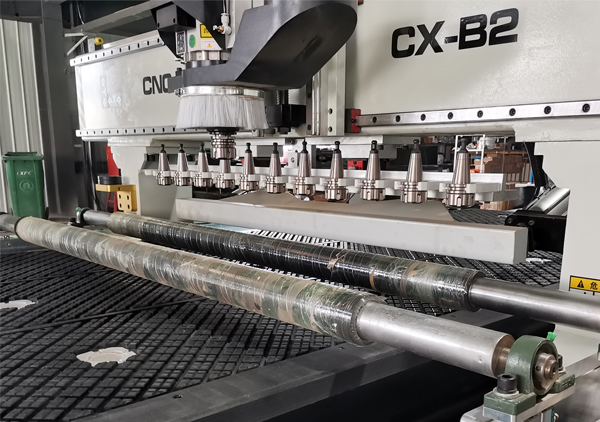
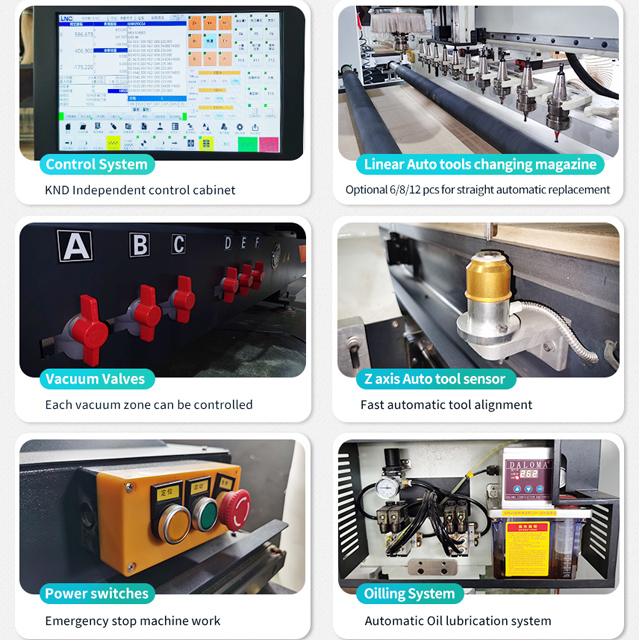
For any growing woodworking business, the biggest dilemma often comes down to one question: "Do I really need an Automatic Tool Changer (ATC), or can I get by with a standard manual machine?"
The price difference is significant, but so is the performance gap. A Traditional (Manual) CNC Router requires the operator to physically stop the machine, use a wrench to change the bit, and re-zero the Z-axis for every single tool change. An ATC CNC Router, on the other hand, does this automatically in seconds.
In this guide, we strip away the marketing hype and compare these two technologies head-to-head based on efficiency, precision, and real-world application.
Performance Showdown: The Core Differences
To make an informed choice, we need to look at the numbers. Here is how they stack up in a production environment.
Feature
Traditional (Manual) CNC
ATC CNC Router
Tool Change Time
3–5 minutes (Stop, Wrench, Zero)
5–12 seconds (Automatic)
Operator Involvement
High (Must be present to change tools)
Low (Load material and walk away)
Human Error Risk
High (Debris in collet, wrong Z-zero)
Low (Sensors verify tool length)
Spindle Type
Standard Spindle (ER Collet)
ATC Spindle (ISO30/BT30 Holders)
Ideal For
One-tool jobs / Hobbyists
Multi-tool jobs / Production
1. Efficiency & Speed
The most obvious difference is speed. If a cabinet door design requires 3 different tools (Roughing, Profiling, Drilling), a manual machine requires the operator to intervene twice per sheet.
Manual: 10 minutes of cutting + 10 minutes of tool changing/setup = 20 mins total.
ATC: 10 minutes of cutting + 20 seconds of tool changing = 10.5 mins total.
Impact: Over an 8-hour shift, an ATC CNC Router can process nearly double the volume.
2. Precision & Repeatability
Manual tool changes introduce variables. If a speck of sawdust gets into the collet when you are swapping bits by hand, your run-out increases. If you re-zero the Z-axis slightly differently, your groove depths won't match.
ATC machines use ISO30 tool holders that are pre-measured and kept clean. The machine knows the exact length of every tool, ensuring every cut is identical to the last.
Application Scenarios: Who Needs What?
Not everyone needs an ATC. Choosing the "best" tool depends entirely on what you are making.
Scenario A: The Custom Cabinet Shop (Winner: ATC)
If you are nesting plywood sheets to make kitchen cabinets, you need to drill 5mm holes, cut 20mm slots, and cut out the perimeter.
Verdict: An ATC is mandatory. The time saved on tool changes pays for the machine upgrade in less than a year.
Scenario B: The Sign Maker / 3D Carver (Winner: Tie)
If you are carving a large 3D relief that takes 4 hours with a single ball-nose bit, the tool change time is negligible.
Verdict: A Manual CNC is often sufficient. However, if you want to run the machine overnight unattended (Roughing + Finishing), an ATC is still superior.
Scenario C: The Startup / Hobbyist (Winner: Manual)
If you are on a strict budget and only process 2-3 sheets a week.
Verdict: Stick with a Manual machine. You can upgrade to an ATC CNC Router later when your volume justifies it.
User Feedback: What Owners Say
We gathered feedback from clients who have used both systems.
The "Manual" Experience:
"I love my manual machine for simple cuts. But on complex days, I feel like a robot—standing there waiting to swap bits with a wrench. It's physically tiring."
The "ATC" Experience:
"Upgrading to an ATC changed my business. I load a sheet, press 'Start', and go assemble drawers. The machine does the work of two people. It’s not just about speed; it’s about freeing up my brain."
Conclusion: The Final Verdict
The choice between an ATC and a Manual CNC Router is a choice between Capital Cost and Operational Cost.
Choose Manual if you have more time than money, or if your projects rarely require more than one tool.
Choose ATC if you are running a business where "Time is Money." The ability to automate complex processes allows you to scale production without hiring more staff.
Ready to see the difference? Compare the specifications in our full ATC CNC Router Product List to find the model that fits your budget.
FAQ: Frequently Asked Questions
Q1: Is an ATC CNC Router much harder to learn?
A: Not really. The design software is identical. The main difference is in the setup—you need to measure your tools once and input them into the tool library. After that, operation is actually easier because you don't have to manually zero the Z-axis for every cut.
Q2: What is the price difference roughly?
A: An ATC machine typically costs $5,000–$10,000 more than a comparable manual machine. This covers the cost of the expensive ATC spindle, the servo motors, the tool magazine, and the more advanced controller.
Q3: Can I buy a manual machine now and add an ATC later?
A: This is a common myth. No, it is usually not feasible. Adding an ATC requires a different controller, different wiring, more pneumatic inputs, and a heavier gantry. It is cheaper to sell the manual machine and buy an ATC one.
Q4: Do ATC machines require more maintenance?
A: Slightly, yes. You need to ensure the air supply is clean and dry (to protect the pneumatic drawbar) and keep the tool sensors clean. However, this is standard for any industrial equipment.