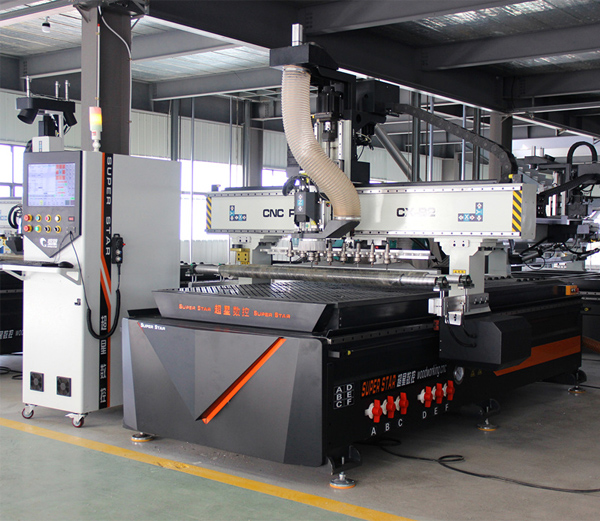
The woodworking industry is undergoing a quiet revolution. The dusty, labor-intensive workshops of the past are transforming into smart manufacturing hubs. At the center of this shift is the ATC (Automatic Tool Changer) CNC Router.
While manual tool-change machines served the industry well for decades, the demand for speed and complex customization has made them a bottleneck. Today, efficiency isn't just a goal; it's a survival requirement.
In this article, we analyze real-world application scenarios where upgrading to an ATC CNC Router has fundamentally changed business models, from mass-produced cabinetry to bespoke artistic creations.
Case Study 1: The Panel Furniture & Cabinetry Revolution
The Challenge:A mid-sized kitchen cabinet manufacturer was struggling with order volume. Their process involved cutting sheets on a table saw, moving them to a drill press for shelf pin holes, and then to a hand router for grooving. This "multi-station" workflow was slow and prone to handling errors.
The ATC Solution:By implementing a heavy-duty ATC CNC Router with a 12-tool carousel, they adopted a "Nesting" workflow.
Process: The machine picks up a 6mm compression bit to cut the outline, automatically swaps to a 5mm drill bit for shelf holes, and then swaps to a V-bit for door panel designs—all in one continuous run.
Result: Production speed tripled. Material waste was reduced by 15% due to optimized nesting software. The machine turned a 3-person job into a 1-person monitoring task.
Case Study 2: Solid Wood Doors & Intricate Decor
The Challenge:A boutique door manufacturer specialized in solid wood doors with deep 3D reliefs and complex lock pockets. Using a manual CNC router meant stopping the machine every 20 minutes to change from a roughing bit to a finishing bit.
The ATC Solution:They upgraded to a 4-axis capable ATC system.
Process: The machine now performs a heavy "roughing" pass with a large end mill to remove bulk material, then automatically switches to a fine tapered ball-nose bit for the detailed carving. Finally, it grabs a specialized aggregate head to bore the lock holes from the side.
Result: The "walk-away" time increased from 20 minutes to 4 hours. Operators could run the machine overnight unattended, drastically increasing output without overtime costs.
Industry Trends: The Future of Woodworking
Looking beyond individual success stories, the broader market data points to a clear future for ATC CNC Routers.
1. "Batch Size One" Production
The market is moving away from mass-producing 1,000 identical chairs. Customers want customization. ATC routers allow shops to switch from making a coffee table to a wardrobe instantly without manual re-tooling. This flexibility is the key to high-margin custom work.
2. Integration with Design Software (CAD/CAM)
The gap between design and production is closing. Modern ATC routers integrate seamlessly with software like Cabinet Vision or Fusion 360. You design the kitchen in 3D, and the software automatically generates the toolpaths and tool change commands for the machine.
3. Smart Factory Connectivity
Industry 4.0 is here. New ATC systems can report data back to the office—tracking cutter life, run times, and material usage. This data-driven approach helps owners calculate costs down to the penny.
Conclusion: The Competitive Edge
The application of ATC CNC Routers in woodworking is no longer just about "cutting wood." It is about process optimization.
Whether you are mass-producing cabinets or crafting high-end acoustic panels, the ability to change tools automatically is the lever that multiplies your workforce's productivity.
If your business is ready to embrace these industry trends and secure a competitive edge, explore our professional ATC CNC Router Product List to find the solution that fits your scale.
FAQ: Frequently Asked Questions
Q1: Can an ATC CNC Router handle materials other than wood?
A: Absolutely. While dominant in woodworking, these machines are widely used for cutting acrylics (signage), aluminum composite panels (cladding), and high-density foam (prototyping). The automatic tool change is equally valuable for switching between plastic-cutting bits and metal-cutting bits.
Q2: Is an ATC router suitable for a small shop?
A: Yes, if the shop focuses on high-value or complex items. If you are a one-person shop making complex furniture, an ATC machine acts like a second employee, handling the boring repetitive work while you focus on assembly and finishing.
Q3: What is the lifespan of an ATC spindle?
A: With proper maintenance (warm-up cycles, clean air supply), a high-quality ATC spindle (like HSD or HQD) can last for many years of daily industrial use.
Q4: Does nesting really save that much material?
A: Yes. Nesting software can rotate and interlock parts in ways a human operator on a table saw cannot. On average, shops report saving 10-20% on sheet material costs.