If you have been researching CNC routers for cabinet making or panel furniture production, you have almost certainly come across the term ATC. Suppliers list it as a premium feature. Industry forums debate whether it is worth the additional investment. And factory owners who have made the switch tend to say they wish they had done it sooner.
But what exactly is an ATC CNC router? How does it work in practice? And — most importantly — does your factory actually need one, or is a standard CNC router the more sensible choice for your current production volume and workflow?
This guide answers all of those questions clearly and practically. It explains the technology, the real-world production benefits, the limitations, and the specific business conditions that make an ATC CNC router a strong investment versus those where a standard machine is the better choice.
Whether you are running a small cabinet shop considering your first upgrade, or managing a furniture factory evaluating a new production line, this guide will help you make an informed decision.
What Does ATC Stand For?
ATC stands for Automatic Tool Changer.
On a standard CNC router, when a job requires a different cutting tool — for example, switching from a compression bit for panel cutting to a V-bit for edge detailing, or to a drill bit for hardware holes — the machine stops, the operator manually removes the current bit, installs the new one, re-zeros the Z-axis, and restarts the program.
On an ATC CNC router, this entire process is automated. The machine stores multiple tools in a tool magazine — typically holding between 6 and 24 tools depending on the configuration. When the cutting program calls for a different tool, the spindle moves to the tool magazine, deposits the current tool in its holder, picks up the required tool, and resumes cutting — all without any operator involvement.
The time required for an automatic tool change is typically 3 to 8 seconds depending on the machine design. A manual tool change by an experienced operator takes 2 to 5 minutes when including the time to stop the spindle, change the collet or tool, re-tighten, re-zero the Z-axis, and restart.
That difference — seconds versus minutes, repeated across every tool change in every job, across every shift of every working day — is the core of the ATC value proposition.
How Does an ATC CNC Router Work?
Understanding the mechanics of ATC helps clarify both its advantages and its requirements.
The Tool Magazine
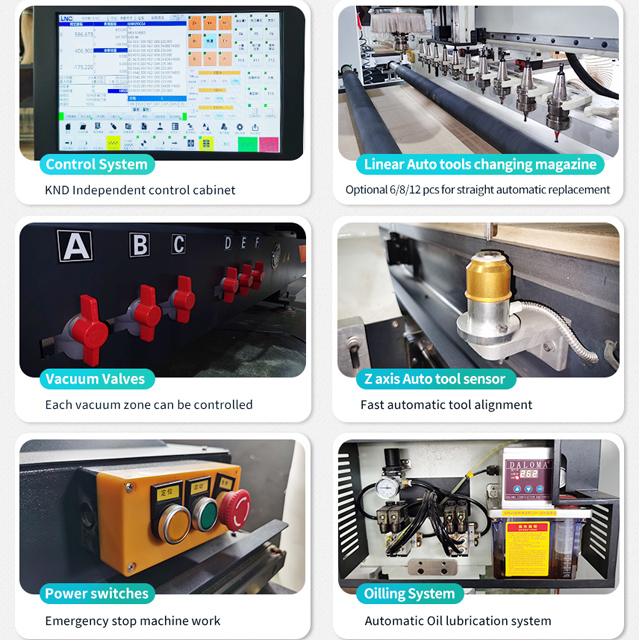
The tool magazine is a rack or carousel that holds pre-loaded tools in numbered positions. Each tool is mounted in a tool holder — typically an ISO 30 or BT 30 taper — that allows the spindle to grip and release tools automatically with precision and repeatability.
Two common tool magazine designs:
Linear tool rack (in-line magazine)
Tools are arranged in a straight row, typically at one end of the machine table or along the gantry beam. The spindle travels to the rack position, deposits the current tool, and picks up the next one. Linear racks are the most common design on woodworking ATC routers and are well-suited to 8 to 16 tool configurations.
Carousel (rotary magazine)
Tools are arranged in a rotating carousel, typically mounted on the gantry. The carousel rotates to bring the required tool into the pickup position. Carousel designs allow faster tool changes and are more common on machines with larger tool counts.
The ATC Spindle
The spindle on an ATC machine uses a pneumatic tool clamping system — compressed air releases and clamps the tool holder automatically. This requires a reliable compressed air supply at the machine, typically at 0.6–0.8 MPa (6–8 bar).
ATC spindles are designed for high repeatability — the tool must return to exactly the same position and orientation every time it is loaded, ensuring consistent cutting geometry and accurate Z-axis positioning without manual re-zeroing after each change.
The Tool Length Offset System
Because different tools have different lengths, the control system must know the exact length of each tool to set the correct Z-axis cutting depth. ATC machines handle this through a tool length measurement sensor — a probe that the machine touches each tool against to measure its length automatically. This measurement is stored in the control system's tool table and applied automatically when each tool is called.
This eliminates the manual Z-axis re-zeroing that is required after every tool change on a standard machine — another significant time saving in multi-tool production workflows.
What Are the Real Production Benefits of ATC?
The benefits of ATC are most visible in production environments where jobs regularly require multiple tools. Here is where the gains are most significant.
Benefit 1: Dramatically Reduced Cycle Time Per Job
Consider a typical cabinet door production job that requires:
A compression spiral bit for panel profile cutting
A V-bit for decorative edge chamfering
An 8mm drill bit for hinge cup holes
A 5mm drill bit for shelf pin holes
On a standard machine, this job requires 4 manual tool changes per panel. At 3 minutes per change (a realistic average including spindle stop, collet change, re-zero, and restart), that is 12 minutes of non-cutting time per panel.
On an ATC machine, the same 4 tool changes take approximately 20–30 seconds total. For a production run of 50 panels, the time saving is approximately 9.5 hours — more than a full shift.
Benefit 2: Reduced Operator Dependency
On a standard machine, the operator must be present and attentive for every tool change. On an ATC machine, the operator can load a panel, start the program, and attend to other tasks — material preparation, quality inspection, loading the next job — while the machine completes the multi-tool cutting sequence automatically.
This effectively increases the productive output per operator and reduces the impact of operator skill variation on production consistency.
Benefit 3: Consistent Tool Change Accuracy
Manual tool changes introduce variability. Different operators tighten collets with different torque. Z-axis re-zeroing by hand has small but cumulative errors. On a production run of hundreds of panels, these small variations add up to measurable inconsistency in cut depth, hole position, and edge profile quality.
ATC tool changes are mechanically consistent every time. The tool holder seats to the same position, the tool length offset is measured automatically, and the cutting parameters are applied identically across every panel in the production run.
With manual tool changes, complex programs that require many tool changes become impractical — the non-cutting time dominates the job. ATC makes it practical to run programs that combine profiling, engraving, drilling, and chamfering in a single uninterrupted sequence.
This opens up product capabilities that are simply not economically viable on a standard machine — particularly for custom furniture, decorative cabinet doors, and architectural millwork where multi-operation machining is the norm.
Benefit 5: Foundation for Lights-Out and Automated Production
ATC is a prerequisite for any meaningful level of automated or semi-automated production. Combined with an automatic loading and unloading system, a labeling system, and a nesting software workflow, an ATC CNC router can run extended production sequences with minimal operator intervention — the foundation of a modern, efficient panel furniture factory.
ATC CNC Router Configurations: What to Know Before Buying
Not all ATC CNC routers are the same. The configuration that suits a custom cabinet shop is different from the one that suits a high-volume flat-pack furniture factory. Here are the key configuration variables to understand.
Number of Tool Positions
ATC tool magazines typically range from 6 to 24 tool positions on woodworking machines.
6–8 positions: Suitable for most cabinet making and general woodworking applications where 4–6 tools cover the full range of operations
12–16 positions: Suited to more complex production workflows with a wider range of operations, or where multiple sizes of the same tool type are kept loaded simultaneously
20–24 positions: For high-complexity production, multi-material operations, or factories running a wide variety of job types without frequent tool magazine reloading
Spindle Power
ATC spindles for woodworking applications typically range from 4.5kW to 12kW. The right power rating depends on your primary materials and cutting parameters:
4.5–6kW: General cabinet making, MDF and particleboard panel processing
7.5–9kW: Heavy solid wood, dense composite materials, high feed rate production
12kW+: Industrial high-speed production, hardwood processing, or operations requiring maximum material removal rate
Integrated Drilling Unit (Boring Block)
Many ATC CNC routers designed for panel furniture production include an integrated multi-spindle drilling unit — sometimes called a boring block or drill bank — in addition to the ATC routing spindle.
This unit holds multiple drill bits in a fixed array and can drill a row of shelf pin holes, hinge mounting holes, or dowel holes in a single plunge — far faster than drilling individual holes with a single routing spindle, even with ATC.
For cabinet and furniture factories where hardware hole drilling is a significant part of the production cycle, an integrated drilling unit is a major productivity feature. Our ATC CNC Router range includes configurations with integrated drilling units specifically designed for panel furniture production.
Saw Blade Spindle
Some advanced ATC configurations include a horizontal saw blade spindle in addition to the vertical routing spindle. This allows the machine to perform straight rip cuts and panel sizing operations that would otherwise require a separate panel saw — consolidating two production steps into one machine.
Control System
ATC machines require a more sophisticated control system than standard CNC routers to manage tool magazine indexing, tool length measurement, and tool change sequences. Common control systems on professional ATC woodworking routers include:
Syntec — A professional industrial CNC control system widely used on mid-to-high-end ATC machines, offering robust tool management, nesting software integration, and reliable performance in production environments
NCStudio — A widely used control system on entry-level to mid-range ATC machines
Siemens / Fanuc — High-end industrial control systems for the most demanding production environments
ATC CNC Router vs Standard CNC Router: Which Is Right for You?
This is the practical question that most buyers need to answer. The following framework helps clarify the decision.
Choose a Standard CNC Router If:
Your jobs typically require only 1–2 tools
If most of your production involves through-cutting and profiling with a single compression bit — for example, a cabinet shop focused on flat-panel carcass production — the time saving from ATC is modest and may not justify the additional investment.
Your production volume is low to medium
If you are running the machine for 2–4 hours per day on a mix of custom jobs, the cumulative time saving from ATC may be less than 30–60 minutes per day. At that production level, the return on the additional ATC investment takes longer to achieve.
Your budget is limited and you are starting out
A well-specified standard CNC router is a better first investment than a poorly specified ATC machine. Start with a reliable standard machine, build your production volume, and upgrade to ATC when the production data justifies it.
Your jobs are highly varied with no fixed production patterns
If every job is unique and requires a completely different tooling setup, the ATC magazine needs to be reloaded frequently anyway — reducing the automation benefit.
Your jobs regularly require 3 or more tool changes
Cabinet door production, furniture panel machining with hardware holes, decorative panel work — any workflow that regularly requires 3 or more tools per job will see immediate, measurable cycle time reduction with ATC.
You are running the machine for 6+ hours per day
At high production volumes, the cumulative time saving from ATC is substantial. A factory running two shifts on a standard machine with frequent tool changes can recover the ATC premium in a matter of months through labor and cycle time savings alone.
You want to reduce operator dependency
If operator skill variation is affecting your output consistency, or if you want to free operators from machine-side attendance during tool changes, ATC directly addresses both issues.
You are planning to scale production
If your business is growing and you are planning to increase production volume over the next 2–3 years, buying an ATC machine now avoids an early replacement cycle and positions your production line for higher throughput from the start.
You are building a panel furniture production line
For flat-pack or RTA (ready-to-assemble) furniture production where nesting, routing, drilling, and labeling are integrated in a production line workflow, ATC is not optional — it is a fundamental requirement of the production system.
What Does an ATC CNC Router Cost?
ATC CNC routers carry a higher purchase price than comparable standard machines, reflecting the additional mechanical complexity of the tool magazine, ATC spindle, pneumatic system, and control system.
As a general reference:
Configuration
Approximate Price Range
Entry-level ATC (6–8 tools, 4.5kW, stepper)
Budget tier
Mid-range ATC (12 tools, 6kW, servo, Syntec)
Mid tier
Production ATC with drilling unit (12–16 tools, 9kW, servo, Syntec)
Professional tier
Full production line ATC with loading/unloading
Premium tier
Note: Prices vary significantly by configuration, market, and supplier. Contact us for a specific quotation based on your requirements.
The more important financial question is not the purchase price but the payback period — how long it takes for the productivity gains to recover the additional investment over a standard machine.
Simple Payback Calculation
For a factory running 8 hours per day, 5 days per week, with jobs averaging 4 tool changes per panel and 20 panels per shift:
Additional panels producible in saved time: approximately 10–15 panels per day
At typical cabinet panel pricing, the value of 10–15 additional panels per day is significant. For most mid-volume production environments, the additional investment in ATC over a standard machine pays back within 6 to 18 months of production.
What to Look for When Buying an ATC CNC Router
If you have decided that ATC is the right choice for your factory, here are the key specification points to evaluate carefully.
Tool Change Speed
Faster is better. Look for machines that complete a tool change in 5 seconds or less. Some entry-level ATC designs take 10–15 seconds per change — significantly reducing the time advantage over a skilled manual operator.
Tool Holder Standard
Confirm the tool holder standard — ISO 30 or BT 30 are the most common for woodworking ATC machines. Ensure that tool holders are readily available in your market and that the collet sizes available cover the shank sizes of the bits you use.
Compressed Air Requirement
ATC spindles require a reliable compressed air supply. Confirm the required pressure and flow rate, and ensure your workshop air compressor can meet this specification consistently. Insufficient air pressure causes tool change failures and spindle clamping issues.
Tool Length Measurement
Confirm that the machine includes an automatic tool length measurement probe. Without this, tool length offsets must be set manually — eliminating one of the key accuracy advantages of ATC.
Control System and Nesting Software Compatibility
Confirm that the control system supports your preferred nesting or CAM software. For panel furniture production, compatibility with professional nesting software is essential for maximizing sheet utilization and production efficiency.
After-Sales Support
ATC machines are more mechanically complex than standard routers. Ensure your supplier has the technical capability to support ATC-specific issues — tool magazine calibration, pneumatic system maintenance, tool holder servicing, and control system configuration. For guidance on evaluating supplier support capability, see our article on what to check before buying a CNC router from a Chinese manufacturer.
Common Questions About ATC CNC Routers
How reliable is the automatic tool change mechanism?
On a well-built machine with proper maintenance, ATC mechanisms are highly reliable. The most common causes of tool change failures are:
Insufficient or inconsistent compressed air pressure
Contamination of the tool holder taper with dust or chips
Worn or damaged tool holders
Inadequate lubrication of the tool magazine mechanism
A regular maintenance routine that includes cleaning tool holders, checking air pressure, and lubricating the magazine mechanism will keep the ATC system operating reliably. For a complete maintenance framework, see our guide on CNC router maintenance tips.
Can I use the same bits in an ATC machine as in a standard router?
The cutting geometry of the bits is the same — compression spirals, V-bits, ball-nose bits, and drill bits all work identically in an ATC machine. The difference is that bits must be mounted in ATC-compatible tool holders (ISO 30 or BT 30 taper) rather than directly in a standard collet chuck.
Tool holders are a recurring consumable cost — they wear over time and must be replaced when they no longer seat accurately. Budget for tool holder replacement as part of your ongoing tooling costs.
Does ATC work with all types of materials?
Yes. ATC is a tool management system — it does not change the machine's material cutting capability. An ATC CNC router cuts the same materials as a standard machine of equivalent spindle power and table configuration: MDF, particleboard, plywood, melamine-faced panels, solid wood, acrylic, PVC foam board, and aluminum composite panel.
How many tools should I have loaded in the magazine?
Load the tools you actually use regularly in production. For most cabinet making operations, a practical magazine setup includes:
1–2 compression spiral bits (different diameters for different operations)
1 spare compression bit (backup for the primary cutting tool)
This covers the majority of cabinet production operations within a 6–8 tool magazine. Additional positions can be used for specialty tools required for specific job types.
What maintenance does an ATC machine require compared to a standard router?
An ATC machine requires all the standard maintenance of a CNC router — guide rail lubrication, spindle care, vacuum system maintenance, spoilboard surfacing — plus additional ATC-specific maintenance:
Regular cleaning of tool holder tapers and magazine pockets
Checking and maintaining compressed air pressure and air line filtration
Lubricating the tool magazine mechanism
Inspecting and replacing worn tool holders
Periodic calibration of the tool length measurement probe
For a complete maintenance schedule covering both standard and ATC-specific tasks, see our guide on CNC router maintenance tips.
Is an ATC CNC Router Right for Your Factory? A Quick Self-Assessment
Answer these five questions to get a clear indication of whether ATC is the right investment for your current situation.
1. How many tool changes does a typical job require?
1–2 tool changes → Standard machine is likely sufficient
3+ tool changes → ATC will deliver meaningful time savings
2. How many hours per day does the machine run?
Less than 4 hours → ATC payback period will be longer
6+ hours → ATC time savings are substantial and payback is faster
3. Is operator availability or skill a production constraint?
4. Are you planning to scale production in the next 2 years?
No → Match the machine to current requirements
Yes → ATC positions you for higher throughput without equipment replacement
5. Is your primary production panel furniture or cabinet making with hardware holes?
No → Evaluate based on questions 1–4
Yes → ATC with integrated drilling unit is strongly recommended
If you answered "ATC" or "Yes" to 3 or more of these questions, an ATC CNC router is likely the right investment for your factory.
Conclusion
An ATC CNC router is not the right machine for every woodworking business. For a small custom shop running 3–4 hours per day on jobs that require only one or two tools, a well-specified standard CNC router is the more practical and cost-effective choice.
But for cabinet factories, panel furniture producers, and any woodworking operation running sustained production with multi-tool jobs, ATC delivers a combination of benefits — reduced cycle time, lower operator dependency, consistent accuracy, and the foundation for automated production — that a standard machine simply cannot match.
The decision comes down to production volume, job complexity, and growth trajectory. Use the self-assessment in this guide to evaluate your own situation honestly, and use the specification checklist to ensure you are comparing ATC machines on the factors that actually matter in production.
If you are ready to explore ATC configurations for your factory, browse our ATC CNC Router range or contact us with details about your production requirements. Our team will recommend the configuration — tool count, spindle power, drilling unit specification, and control system — that best matches your workflow and production volume.
For buyers who are still deciding between a standard machine and ATC, our wood CNC router buying guide covers the full decision framework across all machine types and configurations.
Frequently Asked Questions
What is the difference between an ATC CNC router and a standard CNC router?
The key difference is tool management. A standard CNC router requires an operator to manually stop the machine, change the cutting tool, and re-zero the Z-axis between operations. An ATC CNC router stores multiple tools in an onboard magazine and changes tools automatically in 3–8 seconds when the cutting program calls for a different tool — eliminating manual intervention and dramatically reducing non-cutting time in multi-tool jobs.
How many tools can an ATC CNC router hold?
Most woodworking ATC CNC routers hold between 6 and 24 tools depending on the magazine design and machine configuration. For most cabinet making and furniture production applications, 8–12 tool positions cover the full range of required operations.
Is an ATC CNC router harder to operate than a standard machine?
The day-to-day operation of an ATC machine is not significantly more complex than a standard router for an experienced operator. The main additional skills required are tool magazine management — loading tools into holders, setting up the tool table in the control system, and maintaining the magazine mechanism. Initial setup and configuration is more involved, but once the system is running, production operation is straightforward.
What compressed air supply does an ATC CNC router need?
Most ATC woodworking routers require a compressed air supply at 0.6–0.8 MPa (6–8 bar) with a flow rate sufficient to support the pneumatic tool clamping system. Confirm the specific requirement with your machine supplier and ensure your workshop compressor can meet this specification consistently.
Can a standard CNC router be upgraded to ATC?
In most cases, no. ATC requires a purpose-designed spindle with pneumatic tool clamping, a tool magazine integrated into the machine structure, a tool length measurement system, and a control system capable of managing tool change sequences. These are fundamental design differences, not add-on features. If ATC is a requirement, it should be specified at the time of purchase.
How long does it take to pay back the additional investment in ATC?
Payback period depends on production volume, number of tool changes per job, and the value of the additional panels produced in the time saved. For factories running 6–8 hours per day with 3+ tool changes per job, payback periods of 6 to 18 months are typical. For lower production volumes, payback takes longer but ATC still delivers quality and consistency benefits beyond pure time saving.
Ready to see which ATC configuration suits your factory?
Browse our ATC CNC Router range or contact us with your production details — materials, daily volume, typical job types, and workshop space. Our team will recommend the right configuration and provide a complete quotation.