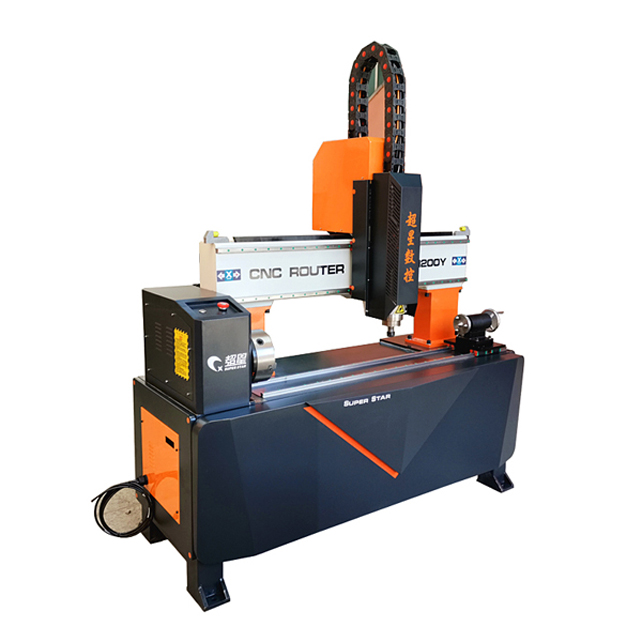
You can have the most advanced Multi-Spindle & Rotary CNC Router on the market, but if the cutting tool is wrong, the result will be mediocre. The router bit is the point of contact—where the "magic" happens.
For multi-spindle setups, the challenge is multiplied: you need consistency across 4, 6, or 8 heads. For rotary axes, you need reach and rigidity.
This guide breaks down the science of tool selection and management to help you achieve the perfect finish, every time.
The Arsenal: Essential Bit Types for Your Machine
Not all bits are created equal. Here are the must-haves for multi-head and rotary work.
1. Tapered Ball Nose (The Rotary King)
Best For: 3D relief carving on rotary axes (statues, table legs).
Why: The "ball" tip creates smooth curves without step-over lines. The "tapered" (conical) shape provides strength, allowing the bit to reach deep into the wood without snapping—crucial for rotary work with deep features.
2. Flat End Mills (The Workhorse)
Best For: Roughing passes, cutting profiles, and flattening surfaces.
Why: They remove material fast. On a Multi-Spindle CNC Router, these are often used in the first spindle for "hogging out" material before the detail tool takes over.
3. V-Bits
Best For: Engraving text, chamfering edges, and decorative grooves.
Why: Essential for sign making and furniture detailing.
Selection Strategy: Matching Tool to Task
Choosing the right tool is a balance of material, speed, and finish.
1. Material Matters
Hardwood (Oak, Walnut): Use Solid Carbide bits. They stay sharp longer under high heat.
Softwood/Foam: High-Speed Steel (HSS) can be used, but Carbide is still preferred for durability.
Plastics/Acrylic: Use "O-Flute" (single flute) bits. These are designed to eject chips rapidly to prevent the plastic from melting and re-welding to the bit.
2. The "Multi-Spindle" Consistency Rule
The Challenge: If you are running 4 spindles, all 4 bits must be identical in type, brand, and wear.
The Risk: If Spindle 1 has a new sharp bit and Spindle 4 has a dull one, the finish on Part #4 will be fuzzy, and the dimensions might be slightly off due to tool deflection. Always replace bits in sets for multi-spindle machines.
Management & Maintenance: Extending Tool Life
Tools are expensive. Proper management reduces your operating costs.
1. The Enemy is Resin (Pitch)
Issue: As you cut wood, resin and sap build up on the bit. This coating increases friction, causing the bit to overheat and dull rapidly.
Solution: Clean your bits daily with a resin remover or simple household cleaner. A shiny bit cuts cooler.
2. Collet Care
Issue: A dirty or worn collet causes "runout" (wobble). Even a microscopic wobble will break fine detail bits and ruin the surface finish.
Solution: Blow out the collet with compressed air every time you change a tool. Replace collets every 400-600 hours of use.
3. Proper Storage
Issue: Carbide is extremely hard but brittle. If bits bang against each other in a drawer, the cutting edges will chip.
Solution: Store bits in a dedicated rack or their original plastic tubes.
Conclusion: Quality is in the Details
The difference between a "good" product and a "premium" product often comes down to the tooling. By selecting the right geometry for your Multi-Spindle & Rotary CNC Router and maintaining a strict replacement schedule, you ensure that your machine performs at its peak potential.
Don't let a $20 bit ruin a $2,000 production run.
FAQ: Frequently Asked Questions
Q1: How do I know when a bit is dull?
A: Listen to the sound. A sharp bit "hums"; a dull bit "screams" or chatters. Also, check the finish—if the wood looks fuzzy or has burn marks, change the bit immediately.
Q2: What is "Chip Load"?
A: Chip load is the thickness of the chip removed by each cutting edge. It is calculated based on Feed Rate and RPM. If the chip is too thin (dust), you are rubbing and creating heat. If it's too thick, you risk breaking the tool.
Q3: Can I use a 3-flute bit for wood?
A: Generally, 2-flute bits are better for wood. They offer more space for chips to escape. 3-flute bits are often used for metals where chip removal is different.
Q4: Why do my bits break on the rotary axis?
A: Usually because the "stick-out" (length of the tool outside the collet) is too long, causing vibration. Use the shortest tool possible, or switch to a Tapered Ball Nose for better rigidity.